WordPress page builders like Elementor and Divi got you this far. But if your website needs to rank higher, load faster, and actually convert — here's what the next level looks like.
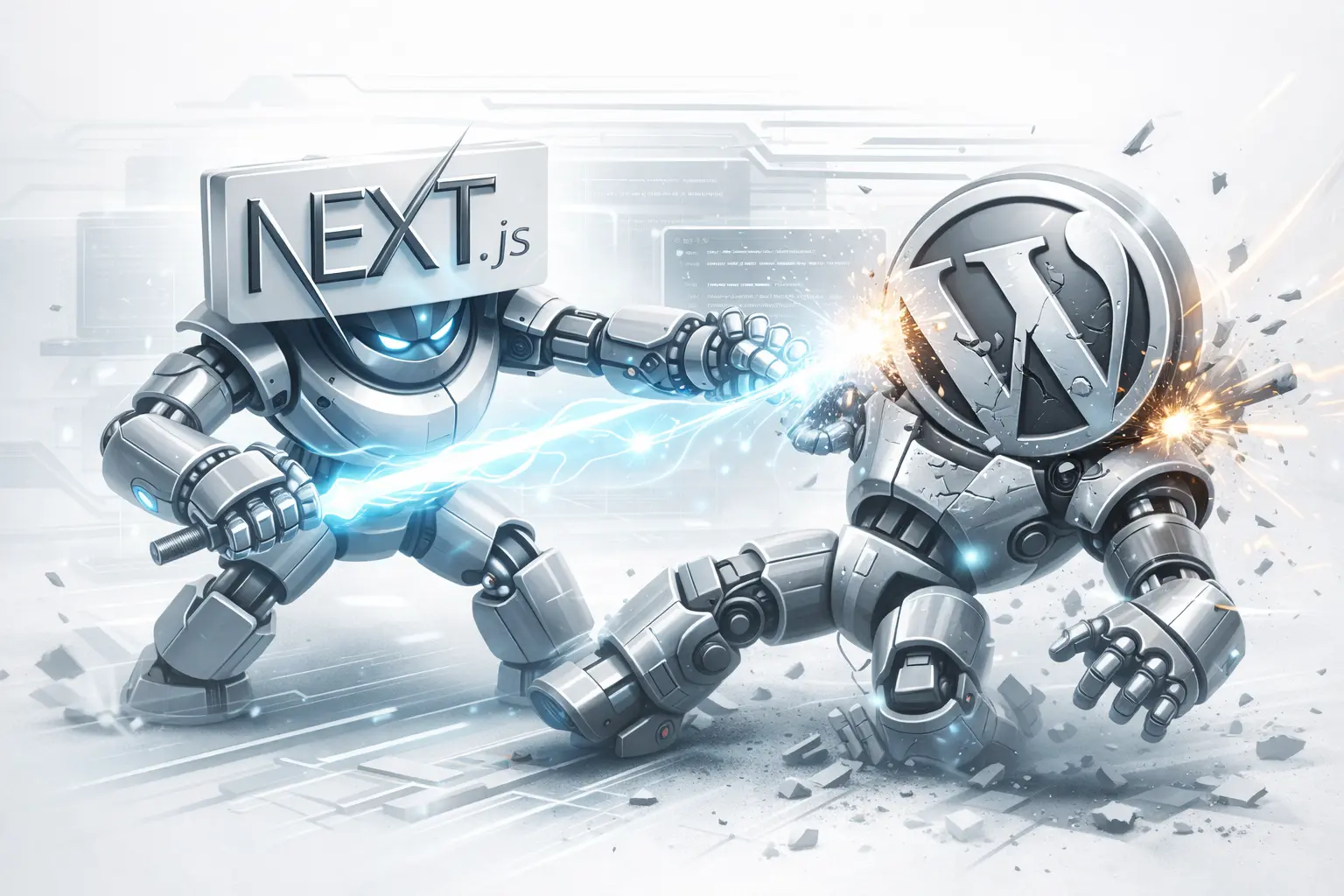
If you're exploring how to build (or rebuild) your website, you've probably come across tools like Elementor, Divi, Wix, or Webflow — drag-and-drop page builders and platforms that make it easy to get a site up quickly. They're beginner-friendly and fast to set up. But there's another approach that fast-growing businesses are increasingly adopting: a custom coded website built with Next.js, a modern framework powered by React.
This isn't about one being "better" in the abstract. It's about understanding what each approach actually does for your business — your Google rankings, your security, your bottom line. Whether you're comparing Elementor vs Divi, considering Webflow, or wondering if a custom website is worth the investment, this guide will help you decide.
01 — Speed & Performance
Here's the thing: your website's loading speed directly impacts how many visitors turn into customers. Google's own research shows that 53% of users leave a page that takes more than 3 seconds to load. That's more than half your traffic — gone. And this applies whether you're on WordPress with Elementor, a Wix template, or a Webflow project.
The Numbers
| Metric | Next.js | WordPress + Page Builder |
|---|---|---|
| Average Load Time | < 1 second | 2–4 seconds |
| First Contentful Paint | ~0.5s | ~2.5s |
| Time to Interactive | ~0.8s | ~3.2s |
A Next.js site uses techniques called Server-Side Rendering (SSR) and Static Site Generation (SSG) — in plain terms, your pages are pre-built and ready to go before a visitor even clicks. There's no database to query, no heavy PHP engine running in the background, no page builder framework loading on top of everything.
Why does this matter? Better performance means better Core Web Vitals — the metrics Google uses to rank your site. Faster site → higher rankings → more organic traffic → more business. It's that simple.
Google recommends pages load in under 2.5 seconds. Next.js sites typically load in under 1 second. WordPress with page builders often exceeds 3 seconds.
02 — Security
This is the part most businesses don't think about until it's too late. WordPress is the most targeted platform on the internet — it receives roughly 90,000 attacks per minute globally. That's not because WordPress is terrible; it's because its architecture (PHP, MySQL database, exposed admin panel) creates a large attack surface.
A custom website (Next.js) is much more secure because:
- It doesn't expose your database to hackers
- It doesn't show PHP vulnerabilities that can be exploited
- It doesn't contain a `/wp-admin` login page susceptible to brute-force attacks
Your site is essentially a collection of pre-rendered files served through a global CDN. The attack surface is nearly zero.
If you use website builders like WordPress or Wix, you're condemned to constantly patching security holes — updating plugins, monitoring for vulnerabilities, dealing with spam. With Next.js, those entire categories of risk simply don't exist.
03 — Scalability & Maintenance
Every WordPress site owner knows the feeling: you update a plugin and something breaks. Or worse, a plugin you depend on gets discontinued. Page builders like Elementor and Divi are products owned by companies — if those companies change their pricing, drop features, or shut down, your entire site is affected.
Even platforms like Wix and Webflow lock you into their ecosystem — you can't easily export your site and take it elsewhere.
With a custom coded website built on Next.js, the code is yours. You're not locked into any third-party ecosystem.
Benefits of a Custom-Coded Website
Deploy Anywhere
Vercel, Netlify, AWS, or your own servers
No Plugin Conflicts
No emergency updates, no "white screen of death"
Portable Codebase
Move it anywhere, any time
Consistent Performance
Doesn't slow down as your content grows
04 — Total Creative Freedom
Page builders give you a selection of pre-made widgets and modules. You drag, you drop, you customize within the limits they've set. Webflow offers more design control than most, and the Elementor vs Divi debate has raged for years — but at the end of the day, all of them constrain you to their system.
The moment you want something truly custom — advanced animations, interactive data visualizations, integrated AI tools, a unique user experience — you hit a wall.
With a custom website built in Next.js, if you can design it, we can build it. There are no module limitations:
- Integrate an AI chatbot that connects to your CRM
- Build an interactive calculator that generates quotes in real-time
- Create a dashboard your clients can log into
- Implement advanced animations and transitions
The websites that stand out, the ones that make visitors think "this company is serious" — those are built with custom code, not with drag-and-drop templates that thousands of other sites use too.
What You Should Know Before Choosing a Custom Website
Custom websites have many advantages over drag & drop sites built on WordPress, but there are aspects to consider before making the leap:
Content Editing
Unlike WordPress where you type directly into a visual editor, Next.js sites need a headless CMS (like Sanity or Strapi) to upload new content.
If your website is static, this doesn't affect you at all. On the other hand, if you regularly publish posts or update your blog, simply ask us to integrate an editor into your project to solve it.
Or even better — ask us about AI-powered automated content generation, optimized for your customers and supervised by you, to boost your project effortlessly.
Initial Investment
A custom Next.js website typically requires a slightly higher investment than a site built with a page builder. After all, you're commissioning a bespoke development: you're paying for engineering, not template assembly.
The good news is that, thanks to AI, development processes are increasingly optimized, which has substantially reduced costs. Custom websites have become democratized and can be adapted to virtually any budget.
And the upfront price difference? It pays for itself in the medium term. A well-built website from scratch requires less maintenance, generates fewer technical issues, and scales without patches. What you save in "putting out fires" more than makes up for the initial investment.
What if I need structural changes?
Adding a new type of section or modifying your website's architecture does require a developer. However, in our experience, the vast majority of websites don't need major structural changes once they're well built from the start.
And if at any point you want to add something new, we're here to help.
What about plugins?
WordPress has thousands of ready-to-install plugins. Next.js doesn't work that way: features are built custom.
But that's actually an advantage. WordPress plugins are one of the main sources of security issues, update conflicts, and website slowdowns. With custom development, every feature is optimized for your project, with no unnecessary code or third-party dependencies that can break.
05 — Side-by-Side Comparison
| Criteria | Next.js | WordPress + Builders |
|---|---|---|
| Load Speed | < 1 second | 2–4 seconds |
| SEO Performance | Excellent Core Web Vitals | Often needs improvement |
| Security | Near-zero attack surface | Constant vulnerability management |
| Maintenance | Minimal — no plugins | Regular updates required |
| Design Freedom | Unlimited | Limited to modules |
| Content Editing | Via headless CMS | Visual drag-and-drop |
| Upfront Cost | Higher | Lower |
| Long-term Cost | Lower (no licenses/plugins) | Ongoing fees add up |
| Scalability | Effortless | Degrades with growth |
06 — The Bottom Line
WordPress page builders, Wix, and even Webflow are fine for simple brochure sites where you need something up quickly and cheaply, and where performance and security aren't critical business drivers.
But if your website is an investment — if it needs to rank well on Google, load instantly, handle growth, stay secure, and represent your brand at its best — a custom coded website built with Next.js pays for itself many times over.
The initial investment is higher, yes. But you save on ongoing maintenance, plugin licenses, security monitoring, and performance optimization. And you get a site that's genuinely faster, safer, and more capable than anything WordPress with Elementor or Divi can produce.
Ready to Outperform Your Competition?
We build high-performance Next.js websites that load fast, rank higher, and convert more visitors into customers — at competitive prices.
Get a Free Consultation →